A “How To” Guide for Marketers Ready for the Next Evolution in Google Ads
How to prepare for the future of AI in advertising? What’s the next evolution after Performance Max (PMax)? In this guide, we’ll explore how artificial intelligence is reshaping marketing strategy — and why Google Ads AI tools are just the beginning of a much larger transformation.
AI-powered ad spending is rising rapidly. AI-driven search ad investments are projected to surge dramatically in the coming years, indicating that advertisers who leverage the next wave of automation and intent-driven targeting will have a huge advantage.
Why AI Is Not Just a Trend — It’s the Future of Advertising
Artificial intelligence has fundamentally changed how ads are created, delivered, and optimized. Traditional keyword-centric approaches are giving way to intent-based, machine-driven targeting that understands why users search, not just what they type. Google’s latest innovations, like AI Max for Search campaigns, reflect this shift — moving beyond rigid match types toward conversational search and personalized intent matching.
What’s really exciting for marketers is that:
- AI doesn’t just automate bidding and delivery — it augments creativity and personalization.
- Campaigns are optimized not just for clicks but for meaningful conversions based on real engagement signals.
In short, AI is rapidly becoming the engine behind smarter audience discovery and messaging, not just campaign automation.
The Evolution: From PMax to What Comes Next
Performance Max (PMax) was Google’s first big leap into unified, automated campaign optimization across inventory — Search, Display, YouTube, and Discover — powered by machine learning.
But what comes next?
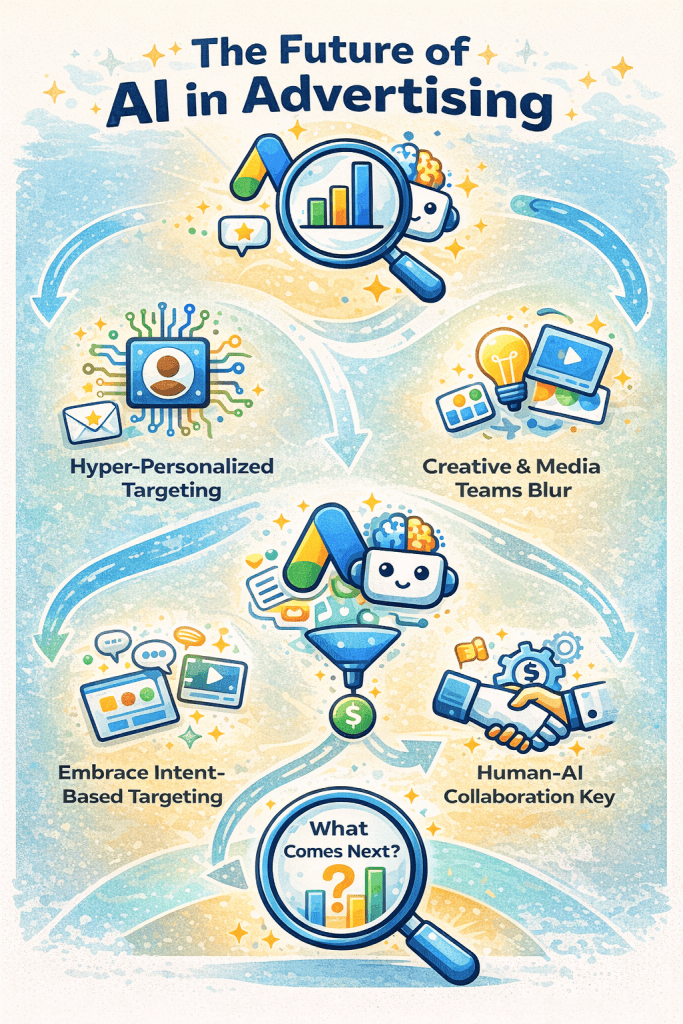
1. Hyper-Personalized Targeting
AI will increasingly interpret user context, sentiment, and intent — far beyond what traditional audience segments can capture.
Google’s AI tools are beginning to interpret nuanced queries (like “best midsize SUVs for family road trips under $35k near me”) and match them to relevant ads without explicit keywords.
2. Creative and Media Blur into One Discipline
As someone who’s spent years as a VP of Digital Media at a top-tier agency in San Francisco, I’ve seen firsthand how AI is dissolving the line between creative and media:
Gone are the days of “creative teams over here” and “media teams over there.” With AI capable of generating tailored ad copy and dynamic creative at scale, strategy and creative execution must happen in lockstep.
Marketers — and organizations — that refuse to adapt will be left behind.
AI will demand more from human teams: creative strategy, brand thinking, and audience empathy are the competitive differentiators that machines cannot fully replicate.
Practical “How To” Steps for Marketers Today
Here’s how to prepare your advertising strategy for a fully AI-driven future:
1. Embrace Intent-Based Signals
Shift focus from exact keywords to user intent and behavior. Tools like AI-Max and intent models help spot patterns humans often miss.
2. Strengthen Creative Inputs
AI tools are only as good as the data and creative they work with. Prioritize assets that communicate value succinctly and adapt across formats.
3. Integrate AI Into Strategic Planning
Think of AI as a partner, not just a tool. AI systems can suggest optimizations, but strategy should still be human-led, especially when it comes to brand identity and narrative.
4. Test, Scale, Learn
Running controlled experiments with AI-enhanced campaigns allows you to benchmark performance, understand causality, and scale what works without blindly trusting automation.
Challenges and Ethical Considerations
AI’s rise isn’t without challenges. As advertising becomes more automated and intent-driven, marketers must think carefully about privacy, transparency, and maintaining brand trust. As search behavior continues to shift toward conversational formats — driven by AI answer engines — brands will need to optimize for responses as much as rankings.
Final Thoughts: What’s Next After PMax?
The journey from manual keyword management to automated systems like PMax is only the beginning. The next era of AI will blur creativity and media, elevate human-AI collaboration, and demand strategic fluency with machine learning insights.
In 2026 and beyond, the marketers who win won’t be those who chase every new tool — but those who understand why AI matters, how to leverage it responsibly, and when to apply human judgment to automated systems.
The future of AI in advertising is here — and it’s far more strategic than we ever imagined.