What It Is, How It Works, Where Ads Show, and Why It’s Dominating Paid Search
If you work in digital marketing today, you’ve likely asked yourself at least one of these questions:
- What is Google Performance Max and how does it work?
- Is Performance Max better than Search, Display, or YouTube campaigns?
- Should Performance Max be the core of my Google Ads strategy in 2026?
This ultimate guide to Google Performance Max (PMax) answers all of that — and more.
As Google continues its aggressive shift toward AI-driven advertising, Performance Max has moved from “nice to test” to central to Google Ads optimization. In 2026, PMax isn’t just another campaign type — it’s the backbone of how Google wants advertisers to buy media.
And speaking from experience as a VP of Digital Marketing in the automotive industry, I’ve seen firsthand why.
What Is Google Performance Max (PMax)?
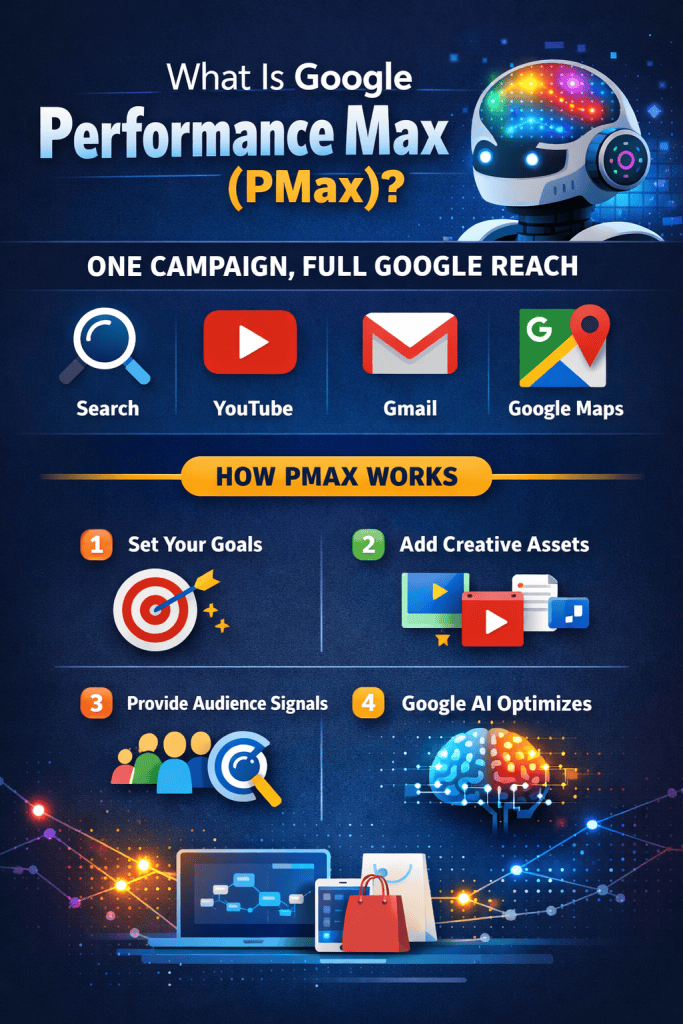
Google Performance Max (PMax) is a goal-based Google Ads campaign type that uses machine learning and automation to deliver ads across all of Google’s inventory from a single campaign.
Instead of creating separate campaigns for Search, Display, YouTube, Gmail, Discovery, and Maps, Performance Max combines them into one unified system optimized toward your chosen business goal.
Performance Max Campaigns Run Across:
- Google Search
- Google Display Network (GDN)
- YouTube
- Gmail
- Discover feed
- Google Maps
- Shopping (for ecommerce or vehicle feeds)
👉 This multi-channel reach is a major reason why Performance Max is dominating paid search in 2026.
How Performance Max Works (A Simple Explanation)
At its core, Performance Max uses Google AI to decide:
- Which audience to show your ads to
- Which creative to serve
- Which channel to use
- Which combination is most likely to convert
Here’s how a PMax campaign works step-by-step:
- You set a goal
Examples: leads, sales, store visits, revenue, or CPA efficiency. - You upload creative assets
Headlines, descriptions, images, videos, logos, and extensions. - You provide signals, not targeting
Instead of keywords and placements, you give:- Audience signals
- Search themes
- Location and conversion data
- Audience signals
- Google’s AI optimizes everything in real time
It tests thousands of combinations across channels and prioritizes what drives results.
This shift — from manual control to AI-assisted performance optimization — is why so many marketers are seeing improved efficiency with PMax.
A VP Perspective: Why PMax Quickly Rose to the Top of Our Marketing Mix
When Performance Max was first introduced, we tested it cautiously.
As a VP of Digital Marketing, I’ve seen enough “new Google products” to know that not all of them live up to the hype. But PMax was different — and the results made that clear very quickly.
We ran side-by-side comparisons:
- Standalone Google Display Network (GDN) buys
- Standalone Gmail Sponsored Ads
- Standalone YouTube campaigns
- Performance Max campaigns using the same budgets and goals
Performance Max outperformed every single one.
- Lower CPAs
- Better scale
- Faster learning periods
- Stronger conversion volume
But the biggest differentiator?
👉 Google Maps placement.
None of Google’s other advertising mediums allowed us to consistently reach users inside Google Maps — a critical moment for intent, especially for brick-and-mortar businesses.
For industries like automotive, retail, and local services, Maps visibility alone can justify Performance Max adoption.
Where Do Performance Max Ads Show?
One of the most searched questions is:
“Where do Performance Max ads appear?”
The short answer: everywhere Google matters.
PMax Ad Placements Include:
- Search results (including brand and non-brand queries)
- Display placements across millions of sites
- YouTube in-stream and in-feed ads
- Gmail Promotions and Social tabs
- Discover feed
- Google Maps listings and directions views
- Shopping results (via product or vehicle feeds)
This is why Performance Max is often misunderstood as a “Display replacement.”
It’s not.
Performance Max is a full-funnel, multi-network campaign powered by intent signals.
Why Performance Max Is Dominating Paid Search in 2026
Performance Max didn’t just gain adoption — it reshaped how Google Ads works.
1. AI-Driven Optimization at Scale
Google’s machine learning now outperforms manual optimizations in most environments, especially when:
- Conversion volume is healthy
- Creative assets are strong
- Goals are clearly defined
2. Fewer Silos, Better Performance
Instead of competing campaigns (Search vs Display vs YouTube), PMax eliminates internal bidding conflicts and reallocates budget dynamically.
3. Search Behavior Has Changed
Users don’t search the same way they did five years ago. They:
- Discover brands on YouTube
- Research in Discover
- Navigate via Maps
- Convert across devices
Performance Max matches this reality better than keyword-only strategies.
4. Google Is Prioritizing PMax
Let’s be honest: Google is clearly investing here.
- New features roll out to PMax first
- Reporting improvements are focused on PMax
- Vehicle Ads, local inventory, and feed-based formats rely on it
If you want to future-proof your Google Ads strategy, Performance Max isn’t optional.
Performance Max vs Traditional Google Ads Campaigns
A common high-volume query is:
“Performance Max vs Search campaigns — which is better?”
The real answer: they work best together, but PMax often becomes the performance driver.
Use Performance Max When:
- You want scale and efficiency
- You have multiple conversion touchpoints
- You rely on local intent or Maps visibility
- You want AI to optimize across channels
Use Traditional Search When:
- You need tight keyword control
- You’re protecting brand terms
- You want clean testing environments
In most mature accounts, Performance Max becomes the primary growth engine, supported by Search and other campaign types.
How to Get the Best Results from Performance Max (Quick Tutorial)
If you’re new to PMax, here’s a simple how-to framework:
1. Start With Clear Conversion Goals
Bad conversion tracking = bad PMax performance.
2. Upload Strong Creative Assets
Performance Max is only as good as what you give it.
- Multiple headlines
- High-quality images
- Native video (not auto-generated only)
3. Use Audience Signals Strategically
Signals guide learning — they don’t limit reach.
4. Be Patient (But Not Passive)
Most PMax campaigns need 2–4 weeks to stabilize.
5. Monitor Incrementality
Compare against:
- Historical performance
- Channel-level benchmarks
- Assisted conversions
Final Thoughts: Why Performance Max Belongs at the Center of Your 2026 Strategy
Performance Max represents a fundamental shift in digital advertising:
- From channels → outcomes
- From keywords → intent signals
- From manual control → AI collaboration
From my seat as a woman VP in a male-dominated auto industry, I’ve learned to trust performance over opinion — and Performance Max consistently earns its place at the table.
It’s not perfect.
It’s not fully transparent.
But it works — and in 2026, that matters more than ever.