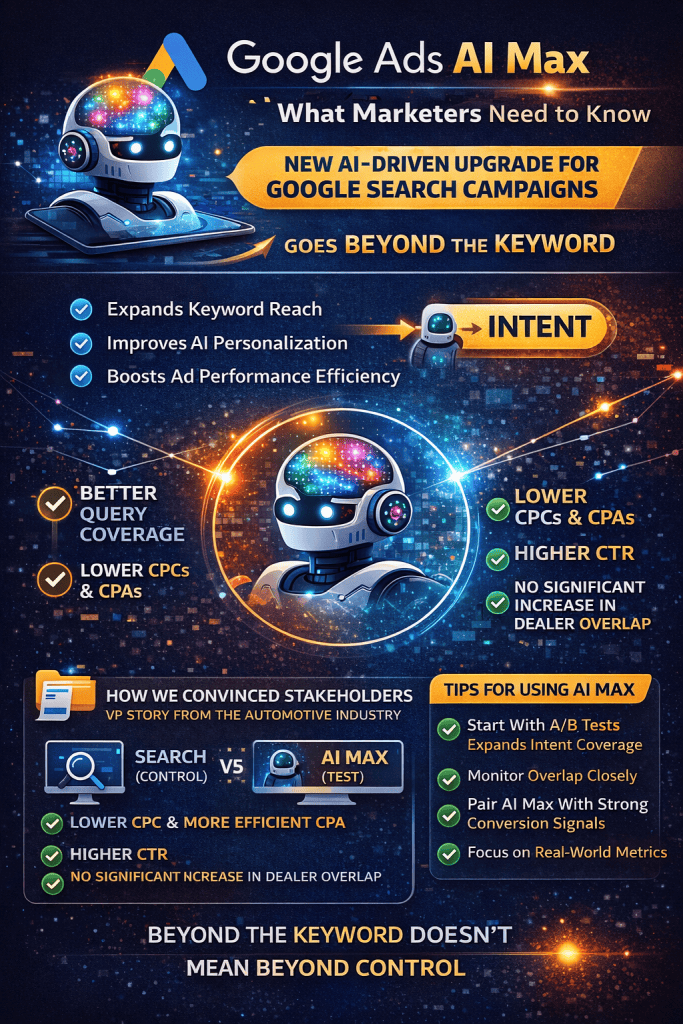
Google Ads is officially moving beyond the keyword — and AI Max for Search campaigns is one of the clearest signals yet of where paid search is headed.
If you’re a marketer wondering:
- What is Google Ads AI Max?
- How does AI Max work in Search campaigns?
- Will AI Max increase overlap, waste, or CPCs?
- Is AI Max safe for complex account structures?
This Google Ads AI Max guide breaks it all down — with real-world insights from the automotive industry, where margin pressure is high and every media dollar is scrutinized.
What Is Google Ads AI Max?
AI Max is an AI-driven enhancement to Google Search campaigns that expands how ads match to user intent using:
- Advanced keyword expansion
- Intent-based query matching
- Improved personalization at auction time
Instead of relying solely on exact queries or close variants, AI Max uses Google’s machine learning to understand what users mean, not just what they type.
Think of AI Max as:
A smarter layer on top of Search that blends keyword intent with AI-powered prediction.
How AI Max Works (In Plain English)
With AI Max enabled, Google:
- Expands reach beyond strict keyword matching
- Uses real-time intent signals (behavior, context, past searches)
- Optimizes bids and ad delivery dynamically
Importantly:
- AI Max does not replace keywords
- It augments them with intent modeling
This is why searches for “Google Ads AI Max keyword expansion” and “AI Max personalization” are rising rapidly.
Why AI Max Is a Big Deal for Search Advertisers
1. Better Query Coverage
AI Max captures high-intent searches you would never think to keyword.
2. Improved Performance Efficiency
Early adopters are seeing:
- Lower CPCs
- More efficient CPAs
- Higher CTR and conversion rates
3. Personalization at Scale
Ads adapt to user intent — not just keyword buckets.
This makes AI Max one of the most significant Search updates since match type expansion.
VP Perspective: Convincing Stakeholders to Trust AI Max
As a VP of Digital Marketing in the highly competitive automotive industry, one truth dominates every conversation:
Every dollar counts.
Search was comforting to stakeholders.
It was predictable.
It fit neatly into the industry’s beloved swim lane strategy.
The Automotive Swim Lane Model
- Corporate → Upper-funnel, broad keywords
- Regional → Mid-funnel, research and comparison terms
- Dealer → Lower-funnel, “ready to buy now” keywords
AI Max, to many senior leaders, felt like a threat to this structure.
The fear?
“Going beyond the keyword will create overlap between national and dealer campaigns and drive up costs.”
How We Broke Through the Resistance: An A/B Test
We didn’t pitch opinions.
We didn’t pitch Google’s roadmap.
We pitched data.
The Test Setup
- One model
- One region
- One campaign with AI Max enabled
- One identical campaign without AI Max (control)
Important Caveats
- No text customization enabled (because all our ad copy requires client approval)
- No final URL expansion activated
Even with those constraints, the results were clear.
AI Max Results vs Control
- Lower CPC
- More efficient CPA
- Higher CTR
- Better conversion rate
But the real test came next.
Did AI Max Increase Dealer or Regional Overlap?
This was the biggest concern — and the biggest myth.
We monitored:
- Overlap rate
- Position above rate
- Auction insights across national, regional, and dealer campaigns
There was no significant increase.
AI Max did not blow up the swim lanes.
It simply found incremental, high-intent users we weren’t capturing before.
That data ended the debate.
How to Use Google Ads AI Max: Practical Tips
1. Start With a Controlled Test
- Test one campaign
- One product or model
- One region
2. Don’t Turn Everything On at Once
You can:
- Enable AI Max
- Hold back text customization or URL expansion initially
This helps stakeholders feel comfortable.
3. Monitor Overlap Metrics Closely
Check:
- Auction overlap
- Impression share
- Position above rate
Data > assumptions.
4. Pair AI Max With Strong Conversion Signals
AI Max performs best when:
- Conversion tracking is clean
- Values are accurate
- Funnel stages are well defined
Common Myths About AI Max
❌ “AI Max replaces keywords”
✅ It expands intent coverage
❌ “AI Max creates massive overlap”
✅ Data consistently shows minimal incremental overlap
❌ “AI Max removes control”
✅ It reallocates control to performance signals that matter
Why AI Max Is a Growing Google Ads Trend
Google is clearly signaling the future:
- Less rigid keyword dependency
- More intent-based matching
- More AI-driven personalization
AI Max is not an experiment — it’s a stepping stone.
For marketers who manage complex, multi-tiered accounts, this evolution isn’t something to fear — it’s something to test intelligently.
Final Thoughts: Beyond the Keyword Doesn’t Mean Beyond Control
AI Max challenged one of the most deeply held beliefs in paid search:
That strict keyword segmentation equals efficiency.
Our test proved otherwise.
By approaching AI Max the way senior leaders think — with structured tests, clean data, and clear guardrails — we unlocked better performance without sacrificing account integrity.
In 2026, the marketers who win won’t be the ones clinging to comfort — they’ll be the ones who know when and how to let AI work for them.