
A practical guide to how Vehicle Listing Ads work through Performance Max—and why they’re quickly becoming the most efficient media channel in automotive marketing.
How Vehicle Ads Work: A Practical Guide for Auto Dealers and OEMs
If you’re an auto dealer or OEM wondering how to drive more qualified leads at a lower cost, chances are you’ve heard about Vehicle Listing Ads (VLAs) and Performance Max (PMax)—but you may not fully understand how they work together or where your ads actually show up.
This guide breaks it all down:
- How Vehicle Ads run through Performance Max
- Where Vehicle Ads appear across Google
- Why VLAs are outperforming search and social
- How dealers and OEMs should avoid competing against each other
- Real performance benchmarks from a first-to-market launch
If you’re looking for a how-to guide to Vehicle Ads for auto dealers and OEMs, you’re in the right place.
What Are Vehicle Listing Ads (VLAs)?
Vehicle Listing Ads are inventory-based ads that dynamically pull vehicle data—such as:
- Make and model
- Trim and year
- Price and incentives
- VIN-level availability
- Dealer location
These ads are powered by a vehicle feed (similar to Shopping ads in retail) and are exclusively delivered through Performance Max campaigns.
That exclusivity is important:
👉 Vehicle Ads do not run in standard Search, Display, or Shopping campaigns.
👉 They only exist within Performance Max, where Google’s machine learning optimizes performance across channels.
How Performance Max Powers Vehicle Ads
Performance Max is Google’s AI-driven campaign type that automatically serves ads across all of Google’s inventory, including:
- Google Search
- Google Shopping
- Google Display Network
- YouTube
- Gmail
- Discover
When Vehicle Ads are enabled inside PMax, Google’s machine learning determines:
- Which vehicles to show
- Which channel to serve them on
- Which users are most likely to convert
- How bids and budgets are optimized in real time
Instead of manually managing keywords or placements, advertisers shift their focus to:
- Feed quality
- Conversion signals
- Inventory coverage
- Auction strategy
Where Do Vehicle Ads Show Up?
One of the most common questions dealers ask is:
“Where do Vehicle Ads actually appear?”
Vehicle Ads can surface in:
- Google Search results (often with images and pricing)
- The Google Shopping tab
- Google Discover feeds
- YouTube (as shoppable inventory formats)
- Display placements across automotive research sites
Because PMax dynamically allocates inventory, you don’t choose placements—Google does, based on likelihood to convert.
A First-to-Market Perspective: Why Vehicle Ads Matter
This is where my experience diverges from much of the commentary on Vehicle Listing Ads.
My agency partnered with the first mass-market auto brand in the U.S. to launch Vehicle Listing Ads with Google for new vehicle sales—giving us a front-row seat to how this format performs at scale.
Since that initial launch, the brand has delivered 13 consecutive months of record-breaking sales.
Are Vehicle Listing Ads solely responsible for that momentum?
No.
But what’s become clear is this: they’ve fundamentally reshaped the efficiency of the media mix.
What the Data Told Us
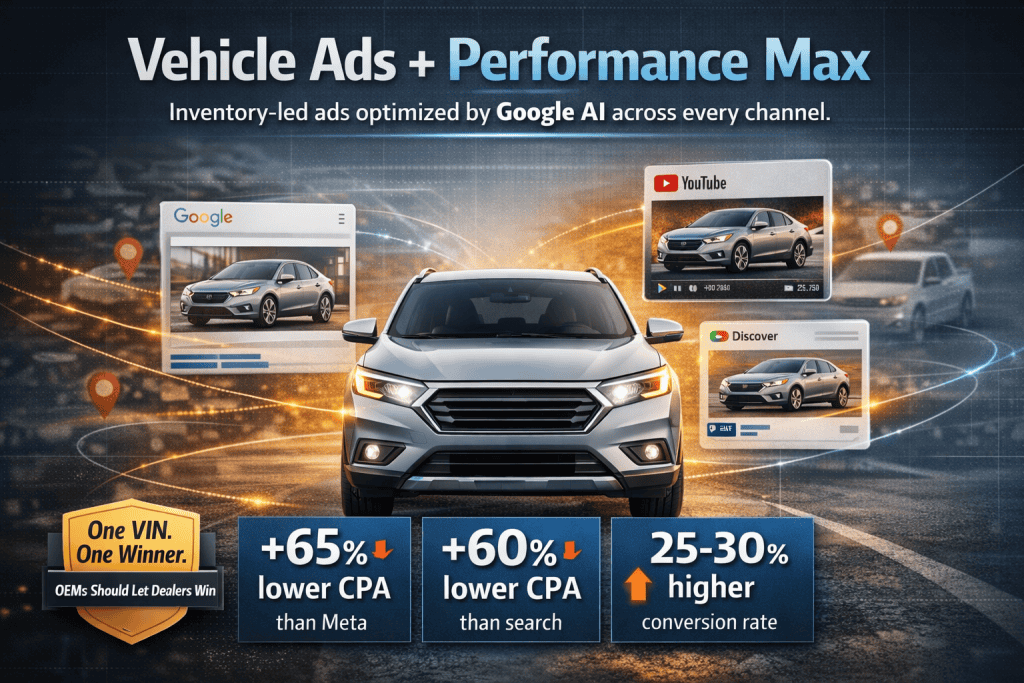
Vehicle Listing Ads quickly emerged as our most efficient channel, driving:
- Over 60% lower acquisition costs than both search and social
- Conversion rates roughly 25–30% higher than either channel
This combination of efficiency and intent has elevated VLAs from a test-and-learn tactic to a primary driver of traffic and leads.
Today, Vehicle Listing Ads play a critical role across:
- The OEM’s national media strategy
- Dealer-level demand generation and inventory movement
In short, VLAs didn’t replace other channels—they raised the performance ceiling for all of them.
Why Vehicle Ads Work So Well for Auto Dealers
Vehicle Ads succeed because they:
- Match real inventory to real shoppers
- Capture high-intent users already in-market
- Reduce friction by showing price, model, and availability upfront
- Leverage Google’s strongest automation and machine learning
Instead of guessing which keywords might work, VLAs let inventory do the targeting.
OEM vs Dealer Strategy: One Critical Warning
This is the part most marketers won’t tell you.
If the OEM and dealer advertise the same VIN, one of you will lose.
When OEMs and dealers compete in the same auction for identical vehicles:
- CPCs inflate
- Efficiency drops
- Someone overpays
This is not a winning strategy.
The Smarter Approach: Let the Dealer Win
My advice—based on real-world execution and performance—is simple:
Let the OEM bow out of the auction and let the dealer win.
Google’s backfill beta allows OEMs to:
- Support dealer demand
- Avoid internal competition
- Maintain visibility without bidding against their own network
This creates:
- Better dealer ROI
- Cleaner auction dynamics
- Stronger OEM–dealer relationships
In short: collaboration beats competition every time.
How to Get Started with Vehicle Ads: A Dealer Checklist
If you’re evaluating Vehicle Ads through Performance Max, start here:
- Ensure clean, accurate vehicle feeds (VIN-level accuracy matters)
- Align OEM and dealer auction strategy
- Optimize conversion tracking (leads, calls, VDP engagement)
- Segment inventory intelligently (new vs used, high-margin models)
- Let PMax learn before over-optimizing
Vehicle Ads reward patience, data quality, and strategic alignment.
Final Thoughts: Why Vehicle Ads Are No Longer Optional
Vehicle Listing Ads aren’t just another beta—they’re quickly becoming a foundational channel for automotive growth.
For dealers, they offer:
- Lower CPAs
- Higher conversion rates
- Inventory-driven demand
For OEMs, they offer:
- Scalable dealer support
- Smarter auction dynamics
- Better alignment across the ecosystem
And for brands willing to execute them correctly?
They offer a competitive advantage that compounds over time.
If you’re serious about driving more leads and sales in automotive, Vehicle Ads through Performance Max aren’t the future—they’re already the present.