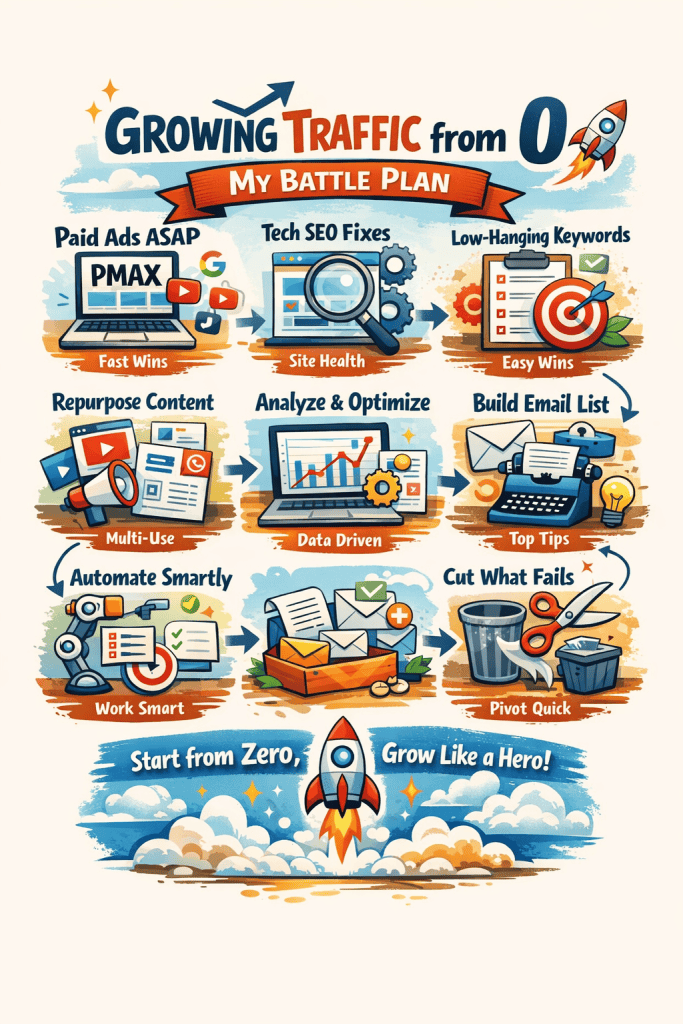
Let’s get something out of the way first: having to grow traffic from 0 is terrifying.
Zero traffic is not a number. It’s a void. It’s an existential crisis wrapped in Google Analytics showing “0 users” and mocking you in real time.
But here’s the thing—if you dropped me into a brand-new site, no authority, no backlinks, no audience, no budget fairy waiting in the wings, I’d still know exactly what to do. I’ve done it before. Multiple times. And if I had to do it again tomorrow, I wouldn’t panic—I’d get tactical.
This isn’t a fluffy “believe in your content” blog. This is what I would actually do to grow traffic from zero in 2026, using modern SEO, paid media, automation, and a healthy amount of sarcasm.
Step 1: Accept That “Organic Only” Is a Romantic Lie
Let’s talk about the biggest myth in digital marketing:
“We’ll just focus on organic traffic.”
Cool. See you in 18 months.
If I had to grow traffic from zero again, I would not sit around waiting for Google to bless my blog posts like some medieval peasant praying for rain. SEO is critical—but SEO alone is slow, competitive, and increasingly algorithm-dependent.
The smartest thing you can do at zero traffic is create momentum fast.
Momentum fuels data.
Data fuels decisions.
Decisions fuel growth.
Which brings me to paid media.
Step 2: I Would Use Performance Max (PMAX) in a Heartbeat
Yes, I said it.
No, I’m not sorry.
If I had to grow traffic from zero again, I would use PMAX in a heartbeat.
Why?
Because I value my time, my sanity, and not crying into an Excel spreadsheet at 11:47 p.m.
Let’s Be Honest About Keyword Builds for a Second
Have you ever:
- Concatenated hundreds of keyword iterations in Excel?
- Grouped them by theme?
- Debated whether “near me” deserved its own ad group?
- Realized you missed plural variations after uploading?
Exactly.
PMAX skips all of that.
Instead of manually building keyword search campaigns like it’s 2012, PMAX lets you focus on:
- Headlines
- Descriptions
- Images
- Video (YouTube links, specifically)
- Audience signals that actually matter
And those audience signals? Chef’s kiss.
We’re talking:
- In-market audiences
- Affinity audiences
- Customer Match lists
- First-party data
- Intent-based signals
- Custom segments
- Search themes
PMAX doesn’t just generate traffic—it generates relevant traffic, especially when your objective is leads or sales.
Real Example: The Non-Profit That Accidentally Proved Paid Media Works
We had a non-profit client—amazing mission, incredible people, absolutely zero budget for paid advertising.
They reached out to us specifically to help maximize a Google Ads Grant campaign. For those unfamiliar, grants come with restrictions, limited flexibility, and historically… mixed results.
Within weeks, they were seeing:
- Record-high traffic
- Record-high conversions
- Engagement metrics they’d never seen before
The impact was so significant that they were able to walk into a board meeting—with data—and convince leadership to “turn on” digital marketing permanently.
That’s not just traffic growth.
That’s organizational mindset change.
And it started with PMAX.
Step 3: I’d Build SEO Like I’m Planning for the Long Game (Because I Am)
Paid traffic gives you momentum.
SEO gives you compounding returns.
If I were starting from zero again, I’d approach SEO with ruthless prioritization.
First: Technical SEO (The Boring Stuff That Actually Matters)
Before publishing a single blog post, I would:
- Fix indexation issues
- Ensure clean site architecture
- Optimize Core Web Vitals
- Set up proper canonical tags
- Implement schema markup where applicable
Because nothing hurts more than writing brilliant content that Google can’t—or won’t—rank.
Second: I’d Target “Low Ego” Keywords
No vanity keywords.
No “we’ll rank for this someday” fantasies.
I’d go after:
- Long-tail keywords
- Problem-based queries
- Bottom-of-funnel phrases
- “How to” searches with clear intent
Think:
- “best [solution] for [specific problem]”
- “alternatives to [competitor]”
- “how to fix [pain point]”
- “is [tool/service] worth it?”
These keywords may have lower search volume, but they convert—and conversions are the oxygen of growth.
Step 4: Content That Actually Deserves Traffic
Here’s a hard truth:
Most content doesn’t deserve traffic.
If I were growing from zero again, every piece of content would need to pass one question:
“Is this genuinely better than what already exists?”
If the answer is “kind of,” it doesn’t get published.
My Content Framework
I’d focus on:
- High-intent blog content
- Comparison posts
- Case studies
- Tactical guides
- Opinionated POV pieces (like this one)
Why?
Because Google increasingly rewards:
- Expertise
- Experience
- Original insights
- First-party data
AI-generated fluff isn’t enough anymore. You need opinion, proof, and perspective.
Step 5: Repurpose Like a Maniac
If I’m writing a 2,000-word blog post, you better believe I’m squeezing every drop of value out of it.
From one blog post, I’d create:
- LinkedIn posts
- Short-form video scripts
- Email newsletter content
- Slide decks
- Quote graphics
- YouTube descriptions
Traffic growth isn’t about doing more—it’s about doing smarter.
Step 6: I’d Use Analytics Like a Weapon
If I had to grow traffic from zero again, I wouldn’t “check analytics.”
I’d live in analytics.
I’d be tracking:
- Traffic sources
- Assisted conversions
- Engagement by channel
- Query-level performance
- Paid + organic overlap
Why?
Because the fastest way to scale traffic is to double down on what’s already working.
SEO informs paid.
Paid informs SEO.
Together, they move faster.
Step 7: Email Lists Are Still Criminally Underrated
Traffic you don’t own is rented.
If I were starting again, email capture would be baked into everything:
- Blog CTAs
- Content upgrades
- Lead magnets
- Webinar registrations
Because when algorithms change—and they will—your email list is the one channel that still shows up.
Step 8: Embrace Automation (Without Losing the Human Touch)
Between:
- PMAX automation
- Smart bidding
- AI-assisted content ideation
- CRM integrations
There is no reason to be doing everything manually anymore.
Automation doesn’t replace strategy.
It replaces busywork.
And busywork doesn’t grow traffic.
Step 9: Be Willing to Kill What Isn’t Working
One of the biggest advantages of starting from zero?
You have no legacy nonsense to protect.
If something doesn’t work:
- Kill it
- Pivot
- Reallocate budget
- Test again
Traffic growth is iterative—not emotional.
Final Thought: Starting From Zero Is Actually a Superpower
If I had to grow traffic from zero again, I wouldn’t be intimidated.
I’d be excited.
Because starting from zero means:
- No bad habits
- No bloated strategies
- No sunk-cost bias
Just clean data, smart tools, strong opinions, and a willingness to move fast.
And yes—
I’d still use PMAX in a heartbeat.
Because traffic doesn’t grow from nostalgia.
It grows from execution.